

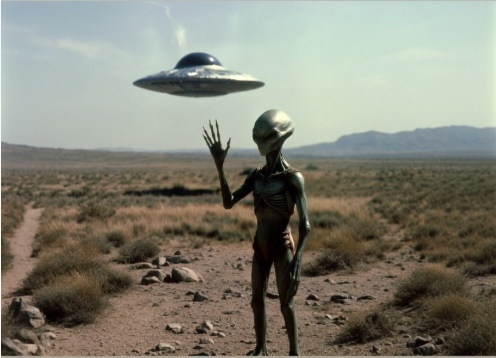
In the 20th Century I believed UFOs existed. And let’s be clear about the terminology, UFO means flying saucers from outer space. Some unidentified flying things were simply unidentified, but there were too many credible witnesses who’d seen these things close up that, on the balance of probabilities, some were indeed alien spacecraft. No one had got a decent picture, because, well if they had a camera it was in the glove box and by the time they’d remembered and retrieved it, the phenomenon was long gone. And film cameras need a good light to get any kind of decent photo.
So when half the world’s population started carrying cameras in their pocket as part of a mobile phone, it was only a matter of time before the evidence started rolling in. Except it didn’t. People instinctively pull out their iPhone to record anything strange, or even take selfies with their lunch. So they would surely take lots of pictures of aliens.
It’s possible, I supposed, that the little green men are cognisant of this change in behaviour and have been keeping a low profile for the last twenty-five years, but I don’t think so. It’s notable that the celebrated Close Encounters of the Third Kind stopped in the 1990s.
But this leaves one little problem – the army of credible witnesses. Could they have all been hallucinating? Some of these are serious people.
Let’s look at a similar aerial phenomenon that took place a bit over 110 years ago, in 1914. The British Expeditionary Force, sent to France to counter the German advance at the start of World War One. Whilst beating a hasty retreat when they discovered the Kaiser’s army was a serious threat they got a bit pinned down at a place called Mons.
Fortunately for Tommy Atkins, a large luminous cloud with silvery beings appeared between the two armies, holding back the Germans and allowing the British to retreat safely. Lots of people saw them, and the newspapers were full of eyewitness accounts. And there were precedents in previous battles going back to at least the middle ages, where angel-like figures had intervened to protect the righteous army. Newspapers printed first-hand testimony accompanied my illustrations. The Church was keen to promote this as divine intervention, publishing accounts in parish magazines and recounting them from the pulpit.
The occurrence at Mons was well documented with updates to the story appearing into the 1930’s, such as Brigadier-General John Charteris’ memoir. This speaks of “an Angel of the Lord, clad in white raiment bearing a flaming sword, appearing before the German forces at the Mons battle forbidding their advance”. A Brigadier-General in the British Army – how’s that for a credible witness?
This was undoubtedly something that happened – too many people saw it, and they can’t have all been hallucinating. Except they were.
The whole thing came from a short story by Arthur Machen called “The Bowmen”, published in The Evening News in London. It wasn’t made clear it was a work of patriotic fiction. One would have assumed that was obvious. But people were all to ready to believe it was a real account of what happened. Witnesses, when asked, didn’t want to be the only people there to have missed it so corroborated it when quizzed. Similar happenings were reported during the course of the war, none of which had any real evidence other than what people said they’d seen. And given the conditions they were fighting in, I have no doubt that reality and imagination would become blurred and many must have genuinely believed their faulty memories. Stress-induced hallucinations.
And that’s the point. Memories are faulty. False memories are created based on suggestion. If you see something strange, confirmation bias kicks in and you see evidence that makes it stranger still.
Occasionally a piece of evidence shows up, like the gun camera footage from US Navy aircraft released about ten years ago, that’s taken as “proof at last”, except that although the pilots couldn’t explain what they were seeing at the time, when experts had a look there were perfectly mundane explanations. The news media, naturally, went with the pilot’s opinion, as without it there was no story.
Much is made of witnesses to these events who are described as “trained observers”. Police, military, pilots are not trained observers. Yes, forensics investigators, the military observer corps* and reconnaissance pilots are trained in observation, but these are exceptions. Other than situational awareness and threat perception, these people are no better or worse at observing and recording detail than the rest of us when it comes to something unusual.
But pilots, police officers and the military are generally pretty level headed people, so in that sense they should be good witnesses. Yet Brigadier-General John Charteris CMG DSO, Chief of Intelligence and later Member of Parliament, still maintained he, along with may others, saw angels in the sky assisting in the fight against the Hun hordes.
So, with the absence of mobile phone photographs or CCTV, no physical evidence, and the knowledge that perfectly respectable and level-headed people can believe they’ve seen things they haven’t, I have to conclude at this stage, that UFOs aren’t real. There are, however, some very strange things seen in the sky and under the ocean that do need explaining.
*The Royal Observer Corps in the UK closed in March 1996, but I’m referring to those in the military whose job it is to gather intelligence.